
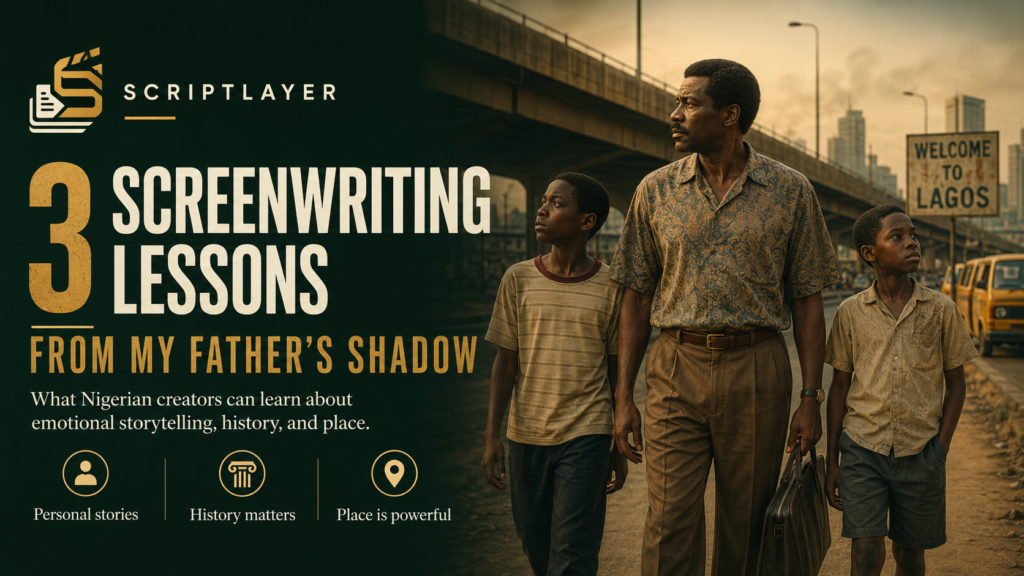
3 Screenwriting Lessons from My Father’s Shadow
Some of the most powerful films do not begin with a complicated plot. They begin with a simple emotional question.
What would happen if two boys were given one full day with the father they barely knew?
That question sits at the heart of My Father’s Shadow, the debut feature directed by Akinola Davies Jr. and written by Akinola and Wale Davies.
Set in Lagos during Nigeria’s 1993 election crisis, the film follows two young brothers, Remi and Akin, as they spend a day travelling through the city with their estranged father, Folarin. What begins as an ordinary family journey gradually becomes more difficult as political unrest spreads across Lagos.
The film received a Caméra d’Or Special Distinction at the 2025 Cannes Film Festival. It later won five awards at the 2026 Africa Magic Viewers’ Choice Awards, including Best Movie, Best Director and Best Writing in a Movie.
Beyond its awards, My Father’s Shadow provides valuable lessons for Nigerian screenwriters who want to create emotional stories with international appeal.
Lesson 1: Begin with an Honest Emotional Question
The film was inspired partly by the filmmakers’ experience of losing their father at a young age. Instead of trying to recreate every detail of their childhood, they built the story around an imagined possibility: spending one meaningful day with him.
That approach is important for writers.
A personal story does not have to be completely factual to feel truthful. The emotional foundation must simply be honest.
Before writing your next screenplay, ask yourself:
What is the emotional question behind this story?
It could be:
- Can a child forgive an absent parent?
- Can two brothers remain close after losing their mother?
- Can someone return home after abandoning their family?
- What would you say to someone you never had the chance to know?
These questions create stories because they contain emotional conflict. They also give the audience something deeper to connect with beyond the visible events.
The lesson is not that every writer must tell an autobiographical story. The lesson is that your screenplay should come from an emotion you understand.
Lesson 2: Let History Affect the Characters Personally
The 1993 Nigerian election crisis is not simply included to make the film appear important. It directly affects the family’s journey.
As unrest spreads through Lagos, transportation becomes uncertain, tension rises and the father’s ability to return his children safely home is threatened.
This is how historical context should work in a screenplay.
A weak historical drama pauses the story so that characters can explain political events to the audience. A stronger drama shows how those events change what the characters can do.
For example, instead of writing a scene where someone delivers a long speech about a fuel scarcity, show:
- A pregnant woman unable to find transport to the hospital.
- A father forced to choose between buying food and buying fuel.
- A delivery driver losing a major client because he cannot move his goods.
- A family becoming trapped in another state after a sudden curfew.
The audience understands the larger situation by watching its effect on ordinary people.
When using Nigerian history, politics or social issues in your script, do not treat them like background information. Make them active forces that place pressure on your characters.
Lesson 3: Allow Locations to Become Part of the Story
Lagos is more than a setting in My Father’s Shadow. The city affects the rhythm, atmosphere and emotional experience of the film.
The boys encounter its crowds, transport systems, streets, businesses, political tension and inequalities as they follow their father through the city.
A well-written location should influence the story.
A romance set in Lagos should not unfold exactly like one set in a quiet village in Ekiti. A thriller set in Kano should not feel identical to one set in Port Harcourt. Every place has its own language, pace, social rules, architecture and daily pressures.
When writing a location, consider:
- What can the characters hear?
- How easily can they move around?
- What kinds of people will they encounter?
- What dangers or opportunities exist there?
- How does the location affect their mood?
- What cultural behaviour is expected in that environment?
Avoid adding random shots of Lagos traffic simply to prove that your story is Nigerian. Connect the environment to the characters’ decisions.
Final Takeaway
My Father’s Shadow shows that a Nigerian story does not need to abandon its identity to reach an international audience.
Its power comes from specificity: a Nigerian family, a recognisable period in Nigerian history and an emotionally complicated relationship between a father and his sons.
The more honestly you understand your characters, the less you need to force the audience to feel something.
Start with one meaningful question. Place your characters under pressure. Then allow their choices to reveal the story.
Have a story idea you want to develop into a screenplay? Scriptlayer can help you organise your characters, scenes, story structure and production journey in one place.